
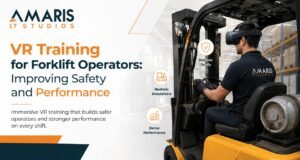
Forklift operations are essential across warehouses, manufacturing facilities, logistics hubs, construction sites, and industrial plants. At the same time, forklift operation involves significant safety risks, especially when operators work around pedestrians, storage racks, loading zones, narrow aisles, and other moving equipment.
Traditional forklift training helps employees understand operating procedures and safety requirements, but it can be difficult to recreate complex or hazardous situations safely during conventional training sessions. This is where VR forklift training can add significant value.
By using immersive simulations, enterprises can allow operators to practice forklift handling, hazard recognition, and emergency response inside a controlled virtual environment before they operate real equipment.
Why Forklift Training Needs More Than Classroom Instruction
Forklift operation is a practical skill. Employees need to understand not only what they should do, but also how to respond when unexpected situations occur.
Classroom sessions, videos, manuals, and instructor-led demonstrations can explain procedures, but they cannot always reproduce the pressure and complexity of a busy industrial environment.
Operators may need to respond to situations such as pedestrians entering their path, unstable loads, obstructed visibility, narrow turning areas, loading dock hazards, incorrect pallet positioning, or sudden changes in operating conditions.
VR training allows these situations to be recreated without exposing employees, equipment, or infrastructure to actual danger.
What Is VR Forklift Training?
VR forklift training uses virtual reality technology to place learners inside simulated forklift operating environments.
Using a VR headset and suitable controllers or simulator hardware, learners can interact with a realistic virtual workplace and practice operational tasks in an immersive setting.
The simulation can recreate warehouses, factories, loading areas, industrial yards, or other work environments based on the organisation’s training requirements.
Instead of only watching how a forklift should be operated, learners actively participate in the training scenario. They make decisions, perform tasks, identify hazards, and experience the consequences of incorrect actions inside the simulation.
Building Safer Forklift Operators Through Virtual Practice
Safety is one of the strongest use cases for forklift VR training solutions.
In conventional training, instructors cannot intentionally create dangerous situations simply to test how an operator responds. Virtual reality removes this limitation.
A VR training module can expose learners to realistic hazards while keeping the training environment completely controlled.
Operators can practice identifying pedestrians, maintaining safe distances, checking surroundings before reversing, navigating restricted areas, handling loads correctly, and responding to unexpected obstacles.
Repeated exposure to these scenarios helps learners develop stronger hazard awareness before they encounter similar situations in the workplace.
Improving Forklift Handling and Operational Performance
Effective forklift training is not only about preventing incidents. It can also support better operational performance.
Forklift operators frequently perform repetitive yet precision-based activities such as picking loads, placing pallets, transporting materials, manoeuvring through narrow areas, and positioning equipment around storage systems.
Virtual training allows operators to repeat these activities without affecting live operations.
Learners can practice until they become comfortable with the sequence of actions required for each task. New operators can develop familiarity before using real equipment, while experienced operators can use simulations for refresher training or scenario-based assessments.
This can help organisations create more confident and consistent operators across their workforce.
Practising High-Risk Scenarios Without Real-World Consequences
One of the major limitations of practical forklift training is the difficulty of recreating high-risk scenarios.
Organisations naturally want operators to understand what can happen when procedures are ignored, but intentionally creating those situations in a live environment would introduce unnecessary risk.
VR provides a safer alternative.
A forklift simulation can demonstrate scenarios involving unstable loads, excessive speed, poor visibility, incorrect turning, collisions, pedestrian interaction, restricted areas, or improper loading practices.
If a learner makes a mistake, the simulation can provide immediate feedback and allow the scenario to be repeated.
The employee learns from the mistake without damaging equipment or putting another person at risk.
Standardising Forklift Training Across Multiple Locations
Large enterprises often operate warehouses, plants, or logistics facilities across several locations.
Maintaining consistent training standards across these sites can become challenging when different instructors, equipment setups, and local training approaches are involved.
VR forklift training creates a repeatable training experience.
The same scenario, operating sequence, safety requirement, and assessment criteria can be delivered to learners across multiple facilities.
For enterprises managing distributed workforces, this provides an opportunity to standardise important parts of forklift operator training while still integrating location-specific procedures where required.
Using Performance Data to Improve Training
Digital simulations can also provide organisations with greater visibility into learner performance.
Depending on the training design, organisations can capture information such as task completion, procedural errors, hazard identification, response time, collisions, incorrect actions, or assessment results.
This information can help trainers understand where an employee may require additional practice.
Instead of relying only on training completion, organisations can begin evaluating how learners actually perform inside realistic scenarios.
This turns VR training into more than an immersive experience. It can become part of a structured, performance-focused training strategy.
Where Forklift VR Training Can Be Used
Forklift VR training can support organisations across industries where material handling forms an important part of daily operations.
This includes manufacturing facilities, warehouses, logistics and distribution centres, automotive plants, metal and engineering facilities, pharmaceutical manufacturing environments, construction operations, oil and gas facilities, and other industrial workplaces.
Training scenarios can also be adapted to specific operating environments, equipment configurations, workflows, and organisational safety procedures.
The objective is not simply to recreate a generic forklift experience. The greater value comes from building training around the situations employees are likely to encounter in their actual workplace.
How VR Complements Practical Forklift Training
VR should be viewed as part of a broader forklift operator development process.
It can help learners build familiarity, practise procedures, understand hazards, and prepare for practical sessions before interacting with real equipment.
A blended approach can combine theoretical instruction, immersive simulation, supervised practical training, and workplace assessment.
This allows organisations to use each training method where it provides the greatest value.
VR provides the controlled practice environment, while supervised practical training validates the learner’s ability to perform safely with actual equipment.
Choosing the Right Forklift VR Training Solution
Enterprises considering forklift VR training should look beyond the headset itself.
The effectiveness of the solution depends on the quality of the training design, realism of the simulation, interaction model, assessment approach, and alignment with actual operating procedures.
A strong solution should reflect the organisation’s workforce, environment, tasks, hazards, and learning objectives.
It should also be easy to deploy, repeatable across learners, and capable of supporting future training requirements as operational needs evolve.
For organisations exploring forklift VR training solutions, customisation can be particularly valuable because it allows training to reflect real workplace conditions rather than relying only on generic scenarios.
Build Safer and More Confident Forklift Operators with Amaris 17 Studios
Amaris 17 Studios develops immersive XR training solutions for enterprises across industrial and high-risk environments.
Our VR training solutions can be designed around operational procedures, workplace hazards, equipment interactions, and realistic training scenarios to help organisations create more engaging and practical learning experiences.
For forklift operator training, this can include immersive material handling scenarios, hazard identification, operational practice, safety procedures, and performance-based assessments.
By allowing operators to practise in a controlled virtual environment before working around real equipment, enterprises can strengthen both safety preparedness and operational confidence.
Looking to introduce VR forklift training into your workforce development strategy?
Explore our forklift VR training solutions and discover how immersive simulation can support safer, more consistent, and performance-focused forklift operator training.