
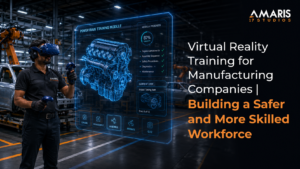
Manufacturing organisations depend on employees who can operate equipment safely, follow complex procedures and respond correctly when unexpected situations arise. However, developing these capabilities through conventional training can be difficult when machinery is expensive, production schedules are tight and mistakes may create serious safety or operational risks.
Virtual reality training for manufacturing companies provides a practical way to address these challenges. It places employees inside realistic, interactive simulations where they can practise tasks, identify hazards and make decisions without affecting live equipment or production environments.
For Indian manufacturers focused on workforce capability, operational safety and digital transformation, VR training can become a valuable part of a wider learning strategy.
Why Manufacturing Training Requires More Than Classroom Instruction
Classroom sessions, videos and standard operating procedure documents are useful for explaining concepts. However, they may not fully prepare employees to perform a task in a complex industrial environment.
Manufacturing employees often need to understand:
- The correct sequence for operating equipment
- Hazards associated with machinery and materials
- Emergency response procedures
- Lockout and tagout requirements
- Inspection and maintenance steps
- Quality and production standards
- Site-specific safety practices
These capabilities are developed through practice. However, practical training on operational machinery can introduce several challenges.
Production equipment may not always be available for training. Experienced trainers may be managing several responsibilities. New employees may also hesitate to practise independently because an incorrect action could damage equipment, interrupt production or create a safety incident.
VR training creates a controlled environment where employees can learn through realistic practice before working independently on the shop floor.
How Virtual Reality Training Works in Manufacturing
Virtual reality training recreates a manufacturing environment as an interactive three-dimensional simulation.
Employees wear a VR headset and use controllers, hand tracking or specialised training devices to interact with machinery, tools and workplace scenarios. They can move through a simulated facility, inspect equipment, complete procedures and respond to situations as they would in the real workplace.
The experience can be designed to include:
- Realistic machinery and control panels
- Standard operating procedures
- Workplace hazards
- Safety equipment selection
- Visual and audio instructions
- Performance feedback
- Assessments and scoring
- Consequences for incorrect actions
This allows organisations to train employees not only on what they should know, but also on what they should do.
Where VR Training Can Create Value in Manufacturing
1. Safety and Hazard Identification Training
Manufacturing facilities may include moving machinery, electrical systems, pressurised equipment, chemicals, confined spaces and material-handling vehicles.
Employees must be able to recognise hazards before those hazards lead to incidents.
A VR safety simulation can place learners inside realistic scenarios where they must identify unsafe conditions, select appropriate personal protective equipment and follow the correct safety procedure.
For example, employees may be asked to recognise:
- Missing machine guards
- Unsafe electrical connections
- Blocked emergency exits
- Improperly stored materials
- Oil spills and trip hazards
- Incorrect PPE usage
- Workers entering restricted areas
The simulation can provide immediate feedback and allow employees to repeat the activity until they demonstrate the required level of awareness.
2. Machine Operation and Equipment Familiarisation
New employees often need time to become comfortable with machinery before they can operate it confidently.
Virtual reality can recreate the machine, its controls and the surrounding work area. Employees can practise start-up, operation and shutdown procedures without interacting with the actual equipment.
This is especially useful when:
- Machinery is expensive or sensitive
- Equipment availability is limited
- Incorrect operation may create safety risks
- Production cannot be interrupted for training
- Several employees need the same training
VR equipment familiarisation can also help employees understand the machine layout, warning indicators and control sequence before receiving supervised practical training.
3. Maintenance and Troubleshooting Practice
Maintenance teams need more than theoretical knowledge. They must identify faults, inspect components and follow the correct maintenance sequence.
A VR maintenance module can guide employees through procedures such as:
- Equipment isolation
- Component inspection
- Part removal and replacement
- Preventive maintenance
- Fault diagnosis
- Tool selection
- Equipment reassembly
- Post-maintenance testing
Employees can repeat difficult procedures without consuming spare parts or taking operational machinery offline.
The simulation can also introduce different equipment faults so that technicians learn to diagnose problems rather than memorising a single procedure.
4. Emergency Response Preparedness
Some workplace emergencies are too dangerous or disruptive to reproduce through live training.
VR enables employees to practise emergency scenarios such as:
- Fire and smoke incidents
- Chemical leaks
- Equipment failure
- Electrical emergencies
- Worker injury
- Emergency shutdown
- Evacuation procedures
The simulation can assess how quickly the learner identifies the emergency, whether the correct alarm is raised and whether the appropriate response procedure is followed.
This creates a more active form of emergency preparedness than simply reading a procedure or watching a demonstration.
5. Standard Operating Procedure Training
Manufacturing performance depends on consistency. When employees follow different methods for the same task, the organisation may experience quality issues, delays and increased operational risk.
VR can convert an SOP into a guided, interactive activity.
The learner completes each step in the correct sequence and receives feedback when a critical action is missed. This can help organisations standardise procedures across different employees, shifts and manufacturing locations.
It is particularly useful for processes that involve:
- Multiple steps
- Safety-critical actions
- Equipment interactions
- Inspection checkpoints
- Quality verification
- Specific tool or component selection
Business Benefits of VR Training for Manufacturing Companies
Safer Practice Without Workplace Exposure
Employees can experience hazardous or high-pressure situations without being exposed to real danger.
This allows organisations to prepare employees for situations that would otherwise be difficult to demonstrate safely.
Reduced Dependence on Live Machinery
VR training can reduce the amount of equipment time required for early-stage training.
Employees can first understand the procedure virtually and then use supervised equipment time to refine practical competence.
Consistent Training Across Locations
A VR module delivers the same process, instructions and assessment criteria each time it is used.
This can help multi-site manufacturers maintain consistent training standards across plants and regions.
Improved Learner Engagement
Employees participate directly in the learning experience rather than passively watching a presentation.
They must observe, decide and act, which can make the training more relevant to their role.
Repeatable Skill Development
Learners can repeat a procedure until they are confident and competent.
Mistakes become part of the learning process rather than a risk to employees, machinery or production.
Measurable Performance Data
VR training can capture information such as:
- Completion time
- Procedural errors
- Missed safety steps
- Hazard identification accuracy
- Decision-making performance
- Number of attempts
- Assessment score
This gives organisations more evidence of capability than course completion alone.
When Should Manufacturers Consider VR Training?
Virtual reality is most valuable when the learning requirement involves actions, decisions or spatial understanding.
Manufacturers should consider VR when:
- The procedure is hazardous
- Equipment training is expensive
- Production access is limited
- Employees must practise emergency responses
- Tasks involve several critical steps
- Mistakes can cause injury or equipment damage
- Training must be standardised across locations
- Employees need realistic practice before workplace exposure
Not every learning topic requires VR. Simple policies, product information or knowledge updates may be better delivered through eLearning or instructor-led sessions.
The technology should be selected because it solves a performance problem, not simply because it is innovative.
What Decision Makers Should Evaluate Before Investing
Define the Workforce Problem
Start by identifying the specific performance gap.
For example, the organisation may need to reduce operational errors, improve hazard awareness or prepare new employees for equipment use.
Select the Right Training Scenario
Choose a use case where immersive practice will provide clear value.
A focused simulation of one critical process is often more effective than a large programme that attempts to cover every topic.
Involve Operational Experts
Safety managers, supervisors, machine operators and maintenance specialists should contribute to the training design.
Their input ensures that the simulation reflects actual workplace conditions and approved procedures.
Plan for Deployment
Organisations should consider headset availability, training space, device management, technical support and the number of employees who will use the solution.
Measure Business Outcomes
Training success should be linked to operational indicators such as:
- Reduced procedural errors
- Faster time to competence
- Improved safety assessment performance
- Fewer trainer-led repetitions
- Better compliance with SOPs
- Increased employee confidence
These measures help decision makers understand whether the VR programme is creating business value.
Building a Safer and More Capable Manufacturing Workforce
Manufacturing organisations need employees who can perform accurately, respond confidently and maintain safe working practices.
Virtual reality makes it possible to provide realistic practice without placing employees, machinery or production at unnecessary risk. It can support safety training, machine operation, maintenance, emergency preparedness and process standardisation across the workforce.
The greatest value comes from connecting immersive technology to a clearly defined operational challenge.
Develop Manufacturing VR Training With Amaris 17 Studios
Amaris 17 Studios develops immersive learning experiences for industrial and enterprise training requirements.
Our virtual reality training solutions can help manufacturing organisations create realistic, repeatable and measurable learning experiences for safety, equipment operation, maintenance and workforce capability development.
Partner with Amaris 17 Studios to transform critical manufacturing procedures into immersive training experiences designed around your workplace, equipment and business priorities.