
Workplace Safety Training: Why Exposure Without Risk Matters
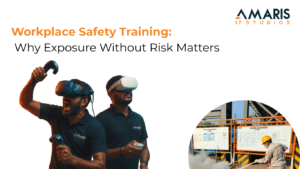
In high-risk industries, safety training is not optional – it is operationally critical. Yet many organisations continue to rely on classroom instruction, static presentations, and limited on-site demonstrations. While these approaches may satisfy compliance requirements, they often fail to build real operational readiness.
The central issue is simple: workers are expected to perform in high-risk environments without being allowed to experience those risks during training.
This is where modern workplace safety training solutions must evolve.
The Gap Between Compliance and Competence
Traditional industrial safety training typically focuses on:
- SOP reviews
- Toolbox talks
- Incident case studies
- Supervisor-led demonstrations
While informative, these methods are passive. They do not expose employees to the decision-making pressure, environmental variables, or procedural sequencing required in real-world scenarios.
Result:
- Hazard recognition remains theoretical
- Response time is slow during real incidents
- Procedural errors increase under stress
- Organisations face recurring safety deviations
Compliance may be achieved. Competence often is not.
Why Exposure Without Risk Is Critical
True safety preparedness requires exposure to:
- Equipment handling under operational conditions
- Hazard identification in dynamic environments
- Emergency response simulations
- Consequence-driven decision-making
However, conducting such exposure in live environments introduces unacceptable operational and legal risks.
A risk-free training environment solves this dilemma.
Through simulation-based training and VR safety training, organisations can replicate hazardous scenarios without exposing employees to actual danger. This allows repeated practice, mistake-based learning, and corrective feedback in a controlled setting.
Exposure becomes structured. Risk is eliminated.
The Business Case for Immersive Safety Training
Decision-makers are increasingly evaluating safety training ROI, not just completion rates.
Effective immersive safety training delivers measurable outcomes:
- Reduced Human Error
Simulated practice strengthens muscle memory and procedural sequencing, reducing operational mistakes.
- Improved Hazard Recognition
Employees trained in dynamic simulations identify unsafe conditions faster than those trained through static content.
- Standardised Training Across Sites
High-risk industry training often suffers from inconsistency across locations. Simulation platforms ensure uniform exposure and assessment standards.
- Data-Driven Workforce Competency Development
Unlike traditional sessions, digital simulations track:
- Reaction time
- Decision accuracy
- Compliance adherence
- Error frequency
This supports structured workforce competency development instead of assumption-based evaluation.
Limitations of Traditional Safety Programs
Even well-designed safety programs face structural limitations:
- Limited repetition due to operational constraints
- Restricted exposure to rare but critical incidents
- Dependence on instructor quality
- Minimal performance tracking
When incidents are infrequent but high impact – such as equipment failure, confined space emergencies, or hazardous material exposure – employees often encounter them for the first time during real operations.
This is an unacceptable risk threshold.
How Modern Workplace Safety Training Solutions Address the Gap
Advanced workplace safety training solutions integrate:
- Scenario-based simulation modules
- Realistic equipment interaction
- Process-specific workflows
- Performance analytics dashboards
Through VR safety training, employees can:
- Practice high-risk procedures repeatedly
- Experience near-miss situations safely
- Understand consequences through immersive feedback
- Build confidence before entering live environments
This approach shifts safety training from informational delivery to experiential mastery.
Exposure Builds Preparedness
Cognitive research consistently shows that experiential learning improves retention compared to passive instruction. When employees actively engage in simulated scenarios, they:
- Retain procedural steps more effectively
- Respond faster under operational stress
- Make fewer critical errors
- Demonstrate higher situational awareness
For industries such as manufacturing, energy, mining, construction, and heavy engineering, this translates directly into reduced incident rates and improved operational continuity.
From Safety Awareness to Operational Readiness
Awareness is knowing the rule.
Readiness is executing correctly under pressure.
The objective of modern industrial safety training should not merely be to inform but to prepare.
By implementing simulation-based training within a structured risk-free training environment, organisations move beyond checkbox compliance and toward measurable safety performance improvement.
Strategic Consideration for Decision-Makers
Investing in immersive and technology-enabled workplace safety training solutions is not a trend-driven decision. It is a risk mitigation strategy.
The questions leadership should ask are:
- Can our employees practice high-risk procedures without operational exposure?
- Are we measuring competency or merely attendance?
- Is our safety program preventing incidents or reacting to them?
Exposure without risk is not an innovation feature – it is a necessity in modern industrial operations.
Organisations that redesign safety training around experiential systems rather than static instruction will not only reduce incidents but also strengthen overall workforce reliability and performance.
Transform your workplace safety trainning with AMARIS17Studios