
In industries where mistakes can lead to serious injuries, operational disruptions, or even loss of life, traditional training methods are often not enough. This is where VR Training for High-Risk Jobs is transforming how organizations prepare their workforce. Instead of relying on classroom sessions or static eLearning modules, companies are now turning to immersive environments that simulate real-world risks without real-world consequences.
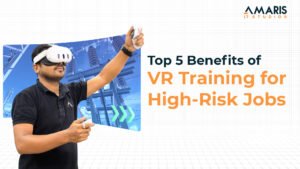
Across sectors such as construction, manufacturing, oil and gas, and healthcare, VR Training for High-Risk Jobs is emerging as a powerful solution to improve safety, engagement, and performance. This article explores the top five benefits of adopting virtual reality-based training in high-risk environments and why forward-thinking organizations are making the shift.
-
Safe Simulation of Dangerous Scenarios
One of the biggest challenges in industrial safety training is exposing employees to real-life risks without putting them in danger. Traditional methods rely heavily on theoretical explanations, which often fail to prepare workers for real situations.
With VR safety training, employees can experience hazardous scenarios in a fully controlled virtual environment. Whether it is handling heavy machinery, working at heights, or responding to emergency situations, learners can practice repeatedly without any physical risk.
This approach allows organizations to:
- Train employees on rare but critical incidents
- Reduce on-site accidents during learning phases
- Build confidence before real-world exposure
By enabling realistic simulations, virtual reality safety training bridges the gap between theory and practice.
-
Improved Learning Retention and Engagement
In high-risk industries, remembering procedures is not optional. It is critical. However, traditional training methods often struggle to keep learners engaged, leading to poor retention.
Immersive training for employees changes this completely.
When learners are placed inside a virtual environment, they are not just reading or watching. They are actively participating. This hands-on involvement significantly improves memory retention and understanding.
Key advantages include:
- Higher engagement through interactive experiences
- Better recall of safety procedures and protocols
- Faster skill acquisition through experiential learning
Studies consistently show that immersive learning leads to better long-term retention compared to passive learning formats. For safety managers and L&D leaders, this directly translates into fewer errors and safer operations.
-
Real-Time Feedback and Performance Tracking
One of the limitations of conventional industrial safety training is the lack of immediate, actionable feedback. Trainers often rely on observations or post-training assessments, which may not accurately reflect real performance.
With VR training solutions, every action taken by the learner can be tracked and analyzed in real time.
This enables:
- Instant feedback on mistakes and correct actions
- Data-driven insights into employee performance
- Identification of skill gaps and training needs
For example, if a worker fails to follow proper lockout-tagout procedures in a simulation, the system can immediately highlight the error and guide the correct process.
This level of precision ensures that training is not just completed but mastered.
-
Cost-Effective and Scalable Training
Training in high-risk environments often involves significant costs. These may include equipment usage, site preparation, instructor time, and potential operational downtime.
VR training for high-risk jobs offers a more scalable and cost-efficient alternative.
Once a virtual module is developed, it can be reused across locations and teams without additional setup costs. Organizations can train multiple employees simultaneously without disrupting operations.
Benefits include:
- Reduced need for physical training setups
- Lower risk-related costs and insurance implications
- Consistent training delivery across global teams
For large enterprises, this scalability makes workplace safety training solutions more sustainable and efficient in the long term.
-
Enhanced Preparedness for Real-World Situations
In high-risk industries, preparedness can make the difference between a controlled response and a catastrophic failure.
Traditional training often lacks realism, making it difficult for employees to react effectively under pressure. In contrast, virtual reality safety training replicates real-world conditions with high accuracy, including environmental factors, equipment behaviour, and emergency scenarios.
This allows employees to:
- Practice decision-making under stress
- Experience consequences of incorrect actions safely
- Build muscle memory for critical procedures
As a result, workers are better equipped to handle real-life situations with confidence and precision.
Why Organizations Are Shifting to VR-Based Safety Training
The shift toward VR training solutions is not just a trend. It is a strategic move driven by the need for better safety outcomes, operational efficiency, and workforce readiness.
High-risk industries are increasingly recognizing that:
- Passive learning is no longer sufficient
- Practical experience is essential for safety
- Technology can bridge training gaps effectively
By integrating immersive technologies into their workplace safety training solutions, organizations are creating a more proactive safety culture.
Where Amaris17Studios Fits In
As industries evolve, the demand for smarter and more effective training approaches continues to grow. This is where Amaris17Studios brings significant value.
With expertise in AR, VR, and MR technologies, Amaris17Studios designs tailored VR safety training programs specifically for high-risk industries. Their solutions focus on:
- Realistic scenario-based simulations
- Industry-specific safety challenges
- Scalable and measurable training frameworks
By combining technology with instructional design expertise, they help organizations move beyond compliance-based training toward performance-driven learning.
Conclusion
The future of safety training in high-risk industries is immersive, data-driven, and experience-focused. VR Training for High-Risk Jobs is not just enhancing how employees learn. It is fundamentally improving how they perform in critical situations.
From safer simulations and better retention to cost efficiency and real-world preparedness, the benefits are clear. Organizations that invest in immersive training today are not only protecting their workforce but also strengthening their operational resilience.
As safety expectations continue to rise, adopting advanced solutions like VR is no longer optional. It is essential for building a safer, smarter, and more capable workforce.