
Why Immersive Learning Is Becoming a Strategic Workforce Development Tool
The oil and gas industry has always operated in environments where workforce competency directly influences safety, operational reliability, and business performance.
Whether it is an offshore platform, refinery, LNG facility, fuel terminal, drilling site, or pipeline network, employees are expected to perform complex tasks while working around high-value assets, hazardous materials, and strict regulatory requirements.
Training has therefore never been optional.
The challenge, however, is that many critical operational scenarios are difficult to recreate using traditional training methods.
Organizations cannot repeatedly simulate refinery emergencies, process upsets, equipment failures, gas leaks, or confined space incidents simply for training purposes. The operational risks, costs, and safety implications are often too high.
This is one of the primary reasons Virtual Reality (VR) training is gaining momentum across the industry.
By creating realistic and immersive digital environments, VR enables employees to experience operational scenarios, practice procedures, and develop decision-making skills without exposing personnel, facilities, or equipment to unnecessary risk.
As workforce development priorities continue to evolve in 2026, organizations are increasingly viewing VR not as a technology initiative, but as a practical training tool that supports workforce readiness, safety performance, and operational excellence.
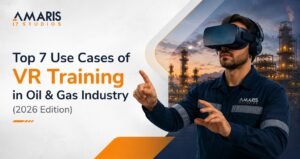
Here are seven areas where VR training is delivering measurable value across the oil and gas sector:
1. Emergency Response and Incident Management Training
In high-hazard industries, emergency preparedness can significantly influence the outcome of critical incidents.
Employees must understand not only emergency procedures, but also how to respond under pressure when alarms activate, equipment fails, or hazardous conditions develop.
Traditional emergency drills remain essential, but they are often limited by operational constraints and the inability to safely recreate realistic emergency situations.
VR enables organizations to simulate:
- Fire emergencies
- Gas leak incidents
- Process upsets
- Equipment failures
- Emergency shutdown procedures
- Facility evacuation scenarios
Trainees can experience these situations in realistic environments and practice making decisions while following established response protocols.
More importantly, scenarios can be repeated multiple times, allowing employees to learn from mistakes without real-world consequences.
2. Refinery and Processing Plant Familiarization
Modern refineries are highly complex operational environments consisting of interconnected systems, pipelines, vessels, pumps, compressors, instrumentation, and control systems.
For new employees, contractors, and operators, understanding how these systems work together often requires significant time and site exposure.
VR allows personnel to explore refinery environments before entering live operational facilities.
Learners can navigate virtual plants, identify equipment, understand process flows, and become familiar with operating areas in a structured and safe environment.
3. Permit-to-Work and Operational Safety Training
Permit-to-Work systems are fundamental to safe operations across oil and gas facilities.
However, understanding permit requirements through presentations and documentation alone does not always prepare workers for real-world application.
VR allows learners to actively participate in simulated work activities where they must:
- Review permits
- Verify isolations
- Identify hazards
- Confirm worksite readiness
- Follow authorization procedures
Rather than memorizing procedures, employees experience how permit systems support operational safety.
4. Equipment Operation and Maintenance Training
Oil and gas facilities depend on the reliable performance of critical assets.
Compressors, pumps, valves, turbines, pressure vessels, rotating equipment, and process systems require skilled personnel capable of operating and maintaining them correctly.
However, access to live equipment for training purposes is often limited.
VR simulations allow employees to interact with digital representations of equipment, understand component functionality, and practice maintenance procedures before working on actual assets.
Training can include:
- Equipment familiarization
- Inspection procedures
- Preventive maintenance
- Operational sequences
- Fault diagnosis
- Troubleshooting workflows
5. Hazard Identification and Risk Awareness
Many workplace incidents originate from hazards that were present but not recognized.
Developing strong hazard recognition skills is therefore a key objective for most health, safety, and environment (HSE) programs.
VR enables organizations to place employees inside realistic operational environments where they must actively identify risks and unsafe conditions.
Examples include:
- Slip, trip, and fall hazards
- Chemical exposure risks
- Electrical hazards
- Confined space dangers
- Unsafe work practices
- Process safety risks
The immersive nature of VR encourages active observation and decision-making, helping employees develop stronger situational awareness.
6. Offshore Workforce Readiness
Offshore operations present unique challenges that differ significantly from onshore environments.
Personnel must be familiar with:
- Platform layouts
- Emergency escape routes
- Muster stations
- Helicopter safety procedures
- Marine transfer operations
- Offshore emergency protocols
For many workers, their first exposure to an offshore platform can be overwhelming.
VR enables organizations to provide virtual site familiarization before deployment, helping employees understand the environment and operational expectations in advance.
7. Workforce Onboarding and Contractor Training
Large oil and gas projects often involve hundreds or thousands of employees, contractors, and subcontractors.
Delivering consistent onboarding experiences across diverse workforces can be challenging.
VR provides a scalable way to standardize training while exposing workers to:
- Site-specific hazards
- Operational procedures
- Emergency protocols
- Safety expectations
- Facility layouts
Organizations can deliver the same learning experience regardless of location, helping create a more consistent foundation for workforce readiness.
Why VR Training Is Gaining Industry Attention
The growing interest in VR training is not being driven by technology alone.
It is being driven by practical workforce challenges.
Organizations are under increasing pressure to:
- Improve safety performance
- Accelerate workforce readiness
- Reduce operational risk
- Preserve critical knowledge
- Support workforce upskilling
- Prepare employees for increasingly complex operations
VR addresses many of these challenges by allowing employees to learn through experience rather than observation alone.
While it is not a replacement for field experience or instructor-led training, it is becoming an increasingly valuable component of modern workforce development strategies.
Final Thoughts
The future of workforce training in the oil and gas industry will likely combine multiple learning approaches, including classroom instruction, digital learning, hands-on practice, and immersive simulation.
Among these, Virtual Reality stands out for its ability to provide practical experience in situations that are difficult, costly, or unsafe to recreate in the real world.
As organizations continue to prioritize workforce safety, operational excellence, and skills development, VR training is evolving from an emerging technology into a strategic capability for workforce readiness.
At Amaris 17 Studios, we help organizations transform complex operational procedures, safety programs, and technical workflows into immersive VR training experiences that support workforce preparedness, engagement, and real-world performance.