
Enterprise VR Safety Training: How Modern Businesses Are Reducing Workplace Risks in 2026
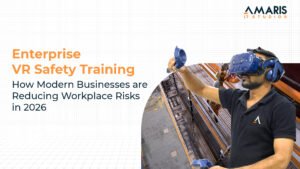
Workplace safety is no longer just a compliance requirement. It has become a business-critical priority.
Yet, many organisations still rely on traditional training methods that fail to prepare employees for real-world risks.
A presentation, a manual, or even a video cannot fully simulate what it feels like to handle a machine failure, respond to a fire hazard, or operate equipment in a high-risk environment.
This is exactly where enterprise VR safety training is changing the game.
By combining immersive simulations with real-world scenarios, organisations are now able to train employees safely, effectively, and at scale.
Why Traditional Safety Training Is No Longer Enough
Many enterprises continue to invest heavily in training. However, the outcomes often do not match expectations.
The problem is not the intent. It is the approach.
Traditional safety training methods often:
- Focus on theory instead of practice
- Lack real-world simulation
- Fail to engage employees
- Do not prepare workers for high-risk situations
As a result, employees may understand safety protocols, but struggle to apply them when it matters most.
This gap between knowledge and action is one of the biggest reasons organisations are adopting virtual reality safety training for enterprises.
What Is Enterprise VR Safety Training
Enterprise VR safety training uses immersive virtual environments to recreate real workplace conditions.
Instead of reading or watching, employees actively participate in simulated scenarios.
They can:
- Interact with equipment
- Identify hazards in real time
- Practice emergency responses
- Experience consequences without real risk
This hands-on approach makes learning more practical, memorable, and effective.
It is also a key part of modern simulation-based training for employees, which is becoming a standard in enterprise learning strategies.
Why Enterprises Are Investing in VR Safety Training
The shift toward enterprise VR safety training is driven by clear business outcomes.
1. Risk-Free Learning Environment
Employees can experience dangerous scenarios without exposure to actual harm.
2. Higher Learning Retention
Immersive learning improves memory by engaging multiple senses.
3. Faster Skill Development
Learning by doing accelerates understanding and performance.
4. Consistent Training Across Locations
Standardised VR modules ensure uniform safety training globally.
5. Data-Driven Insights
VR platforms track performance, behaviour, and decision-making.
This data allows organisations to continuously improve training effectiveness.
Key Use Cases of VR Safety Training in Enterprises
One of the biggest strengths of VR is its versatility across industries.
Workplace Hazard Identification
Employees learn to recognise risks such as:
- Electrical hazards
- Unsafe equipment handling
- Slips, trips, and falls
This builds strong situational awareness.
Emergency Response Training
VR allows employees to practice:
- Fire evacuation
- Emergency shutdown procedures
- Incident response protocols
These scenarios are difficult and dangerous to replicate in real life.
Equipment Operation Training
Workers can operate machinery in a virtual environment before handling real equipment.
This reduces errors, accidents, and downtime.
Compliance and Safety Protocol Training
Organisations can ensure employees follow safety standards through interactive simulations instead of passive learning.
The Role of XR in Modern Safety Training
Enterprise safety training is no longer limited to VR alone.
Many organisations are adopting XR-based training solutions, which include:
Virtual Reality (VR)
Fully immersive environments for high-risk scenario training
Augmented Reality (AR)
Real-time guidance layered onto physical environments
Mixed Reality (MR)
A combination of digital and real-world interaction for advanced simulations
Together, these technologies are transforming how enterprises approach workforce training and safety.
Challenges Enterprises Must Address
While the benefits are clear, successful implementation requires the right strategy.
Lack of Alignment with Business Goals
VR must support real operational and safety objectives.
Generic Training Content
Off-the-shelf simulations may not match actual workplace risks.
Integration with LMS Systems
VR must fit into existing learning ecosystems.
Measuring ROI
Organisations need clear metrics to track training impact.
Addressing these challenges is critical to maximise the value of VR safety training solutions.
How Amaris17 Studios Supports Enterprise VR Safety Training
Amaris17 Studios helps organisations move beyond basic training and build impactful safety programs.
Custom VR Safety Training Development
Industry-specific simulations tailored to real environments
End-to-End XR Solutions
From design to deployment and integration
Focus on High-Risk Industries
Manufacturing, construction, energy, and logistics
Scalable Learning Solutions
Training that works across multiple locations
Performance Tracking and Analytics
Actionable insights to improve training outcomes
This approach ensures that training is not only immersive but also aligned with business results.
Conclusion
Enterprise VR safety training is no longer optional. It is becoming essential.
Traditional methods cannot fully prepare employees for real-world risks.
Immersive training bridges that gap.
By combining simulation-based learning with real-world scenarios, organisations can create safer, more efficient workplaces.
Amaris17 Studios enables this transformation by delivering customised, scalable, and results-driven VR safety training solutions.
For businesses looking to improve safety, performance, and long-term outcomes, the shift to VR is not just a trend.
It is the future.