
How Virtual Reality (VR) Used in Enterprises to Train Workforce in 2026
Virtual Reality (VR) is no longer limited to gaming or entertainment. Virtual Reality (VR) used in enterprises today is transforming how organizations train employees, improve safety, collaborate remotely, nd innovate faster.
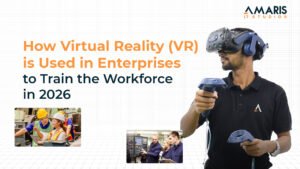
VR creates immersive, computer-generated environments where users can interact in real time. This ability to simulate real-world scenarios in a controlled setting is what makes VR highly valuable for businesses.
As organizations across industries focus on efficiency, safety, and scalability, immersive technologies like VR are becoming essential tools. From manufacturing floors to corporate boardrooms, VR is reshaping enterprise operations and redefining how employees learn and perform.
Why Enterprises Are Adopting VR
Enterprises are under constant pressure to improve productivity, reduce costs, and ensure workforce readiness. Traditional training and collaboration methods often fall short in delivering real-world experience.
This is where VR steps in.
By enabling experiential learning and simulation-based training, VR helps organizations bridge the gap between theory and practice. It allows employees to “learn by doing” without real-world risks.
Key Use Cases of VR in Enterprises Today
1.Employee Training and Development
One of the most powerful applications of Virtual Reality (VR) used in enterprises today is employee training.
Organizations are increasingly adopting VR training for enterprises to deliver:
- Scenario-based learning
- Skill-based simulations
- Interactive problem-solving exercises
Instead of passive learning, employees actively engage in realistic environments. This leads to better understanding and faster skill development.
2.Workplace Safety Training
In high-risk industries such as mining, construction, oil and gas, and manufacturing, safety training is critical.
Workplace VR safety training allows employees to:
- Experience hazardous situations safely
- Practice emergency responses
- Understand risks without exposure to real danger
For example, workers can simulate fire incidents, equipment failures, or confined space operations. This significantly improves preparedness while reducing accidents.
3.Onboarding and Employee Orientation
VR is also transforming how companies onboard new employees.
Instead of traditional presentations, new hires can:
- Explore virtual office environments
- Understand workflows through simulations
- Experience company processes interactively
This creates a more engaging onboarding experience and helps employees become productive faster.
4.Remote Collaboration and Virtual Meetings
With global teams becoming the norm, enterprises are using VR to enhance collaboration.
Virtual meeting spaces allow teams to:
- Interact in 3D environments
- Conduct immersive presentations
- Collaborate as if they are physically present
This is especially useful for distributed teams that require high levels of coordination and engagement.
5.Product Design and Prototyping
VR enables organizations to visualize and test products before they are physically built.
Teams can:
- Create virtual prototypes
- Identify design flaws early
- Collaborate on product development in real time
This reduces development costs and accelerates time to market.
Benefits of Using VR in Enterprises
Improved Learning Retention
Studies consistently show that immersive learning leads to higher retention compared to traditional methods.
With immersive learning solutions, employees remember more because they actively participate in the learning process.
Reduced Training Costs
Although initial investment may seem high, VR reduces long-term training costs by:
- Eliminating the need for physical setups
- Reducing travel expenses
- Minimizing instructor dependency
Risk-Free Simulation Environments
VR allows organizations to simulate dangerous or complex scenarios without real-world consequences.
This is particularly valuable in industries where mistakes can be costly or life-threatening.
Increased Engagement and Productivity
Traditional training often lacks engagement. VR, on the other hand, captures attention and keeps learners involved.
Engaged employees:
- Learn faster
- Perform better
- Make fewer errors
Real-World Applications of VR in Enterprises
Across industries, organizations are already leveraging Virtual Reality (VR) used in enterprises today in practical ways:
- A manufacturing company uses VR to train machine operators before they work on actual equipment
- A construction firm simulates site conditions to train workers on safety protocols
- A logistics company uses VR to optimize warehouse operations and employee training
- A corporate organization conducts leadership training through immersive role-play scenarios
These applications demonstrate how VR is not just innovative, but also highly practical and scalable.
The Future of VR in Enterprises
The future of Virtual Reality (VR) used in enterprises today looks highly promising.
Key trends include:
- Integration with AI for adaptive learning
- Expansion of mixed reality environments
- Increased adoption in remote work ecosystems
- Wider use in customer experience and sales
As hardware becomes more affordable and technology evolves, VR will become a standard tool in enterprise operations.
Why Partner with Experts for VR Implementation
Implementing VR successfully requires more than just technology. It requires strategy, design expertise, and industry understanding.
Companies like Amaris 17 Studios specialize in delivering enterprise-grade VR solutions tailored to business needs.
They help organizations with:
- Design immersive learning experiences
- Develop scalable VR solutions
- Integrate VR into existing training ecosystems
Conclusion
Virtual Reality is no longer a future concept. It is actively shaping how businesses operate today.
From training and safety to collaboration and innovation, Virtual Reality (VR) used in enterprises today is driving measurable business impact.
Organizations that adopt VR early gain a competitive advantage by building a more skilled, efficient, and engaged workforce.
Partner withAmaris 17 Studiosto transform your enterprise training with immersive VR solutions and unlock the full potential of your workforce.