
AR & VR Based Training for Workforce Development: Transforming How Enterprises Train Their Teams for High-Risk Jobs
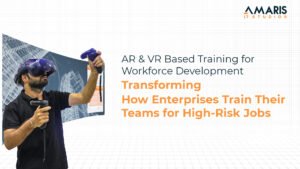
One of the biggest challenges organizations face today is training employees for environments where mistakes are not just costly, but dangerous.
In industries such as construction, manufacturing, energy, and heavy engineering, employees are regularly exposed to:
- Hazardous equipment
- High-risk operational processes
- Unpredictable working conditions
- Strict safety and compliance requirements
Traditional training methods struggle in these environments. It is often not practical, or even possible, to recreate real-life scenarios without exposing employees to actual risk.
This creates a critical gap. Employees may understand procedures in theory, but lack the confidence and experience to respond effectively in real situations.
This is exactly where immersive learning is making a significant impact.
What is AR & VR Training?
At a basic level, AR and VR training use immersive technologies to simulate real work environments.
- Virtual Reality (VR) places employees inside a fully digital environment where they can interact with equipment, scenarios, or processes.
- Augmented Reality (AR) overlays digital information onto the real world, helping employees perform tasks with guided support.
- Mixed Reality (MR) blends both, allowing interaction between real and virtual elements.
Instead of reading instructions or watching videos, employees actively participate in learning.
This is what defines modern immersive training solutions. They move training from theory to experience.
Why Traditional Training Falls Short
Despite significant investment in training, many organizations still face recurring issues.
Safety Risks During Training
Hands-on training in industrial environments often exposes employees to real hazards.
Limited Practical Exposure
Employees may understand concepts but lack confidence in applying them on the job.
Low Engagement
Passive formats such as slides or lectures fail to hold attention for long.
Inconsistent Training Quality
Training outcomes vary depending on instructors, locations, or conditions.
High Costs
Travel, equipment usage, and downtime make traditional training expensive to scale.
These challenges directly impact performance, safety, and operational efficiency.
How AR & VR Training Solves These Challenges
This is where VR training solutions and AR-based approaches offer a clear advantage.
Immersive Learning Experience
Employees learn by doing, not just observing. They can interact with equipment, processes, and environments in a realistic way.
Safe Training Environment
High-risk scenarios can be simulated without exposing employees to actual danger.
Better Knowledge Retention
Experiential learning improves memory and understanding compared to passive learning.
Consistent and Scalable Delivery
Training can be standardised and delivered across locations without variation.
On-Demand Access
Employees can repeat training modules as needed, improving confidence and competence.
For organizations, this means training becomes more effective and more aligned with real-world performance.
Key Use Cases of AR & VR Training
Safety Training
Safety is one of the most critical areas where immersive learning delivers value.
With VR safety training, employees can experience hazardous scenarios such as:
- Equipment malfunctions
- Fire or emergency situations
- Confined space risks
- Electrical hazards
They learn how to respond correctly without facing real danger.
This approach improves preparedness and reduces workplace incidents.
Industrial Skills Training
Industrial environments require precision and hands-on experience.
Using immersive simulations, employees can:
- Practice operating machinery
- Learn maintenance procedures
- Understand complex workflows
This reduces dependency on physical equipment and minimises operational disruption.
Technical Training
Technical roles often involve complex systems that are difficult to explain through traditional methods.
With AR training for employees, organizations can:
- Overlay instructions on real equipment
- Guide step-by-step processes
- Reduce errors during task execution
This is especially useful for field technicians and maintenance teams.
Employee Onboarding
New employees often take time to understand processes, environments, and safety protocols.
Immersive onboarding allows them to:
- Explore virtual workplaces
- Learn procedures before entering real environments
- Build confidence from day one
This leads to faster integration and improved early performance.
Business Benefits of AR & VR Training
Adopting AR & VR training for workforce development is not just about innovation. It delivers measurable business value.
Reduced Workplace Accidents
Employees are better prepared to handle risks, leading to fewer incidents.
Cost Efficiency
Training can be repeated without additional resource or equipment costs.
Faster Skill Development
Employees gain practical experience in a shorter time.
Scalability
Training can be deployed across multiple locations with consistent quality.
Improved Performance
Employees are more confident and capable in real work situations.
For many organizations, these benefits directly impact productivity, safety metrics, and overall operational performance.
The Role of Technology in Workforce Training
Modern workforce training solutions are supported by integrated digital platforms.
These include:
- Learning systems that track progress and performance
- Data analytics to measure training effectiveness
- Cloud-based delivery for global accessibility
When combined with immersive technologies, training becomes not just interactive, but also measurable and continuously improving.
How Amaris 17 Studios Supports Workforce Development
As industries adopt immersive learning, the need for specialised expertise becomes important.
Amaris 17 Studios focuses on designing and delivering practical, scalable immersive training solutions tailored to enterprise and industrial needs.
Their approach includes:
- Developing customised VR training solutions for real-world scenarios
- Creating AR training for employees to support on-the-job performance
- Designing safety-focused simulations for high-risk environments
- Aligning training experiences with operational goals
Rather than offering generic content, the focus is on building training that reflects actual workplace challenges.
This ensures that learning translates into real performance improvements.
Conclusion:
Workforce training is moving toward more practical, experience-driven approaches.
As industries become more complex and safety expectations increase, traditional methods alone are no longer enough.
AR & VR training for workforce development is helping organizations bridge the gap between knowledge and application.
It enables employees to learn in realistic environments, build confidence, and perform better in real-world situations.
For enterprises looking to improve safety, efficiency, and skill development, immersive learning is quickly becoming a